
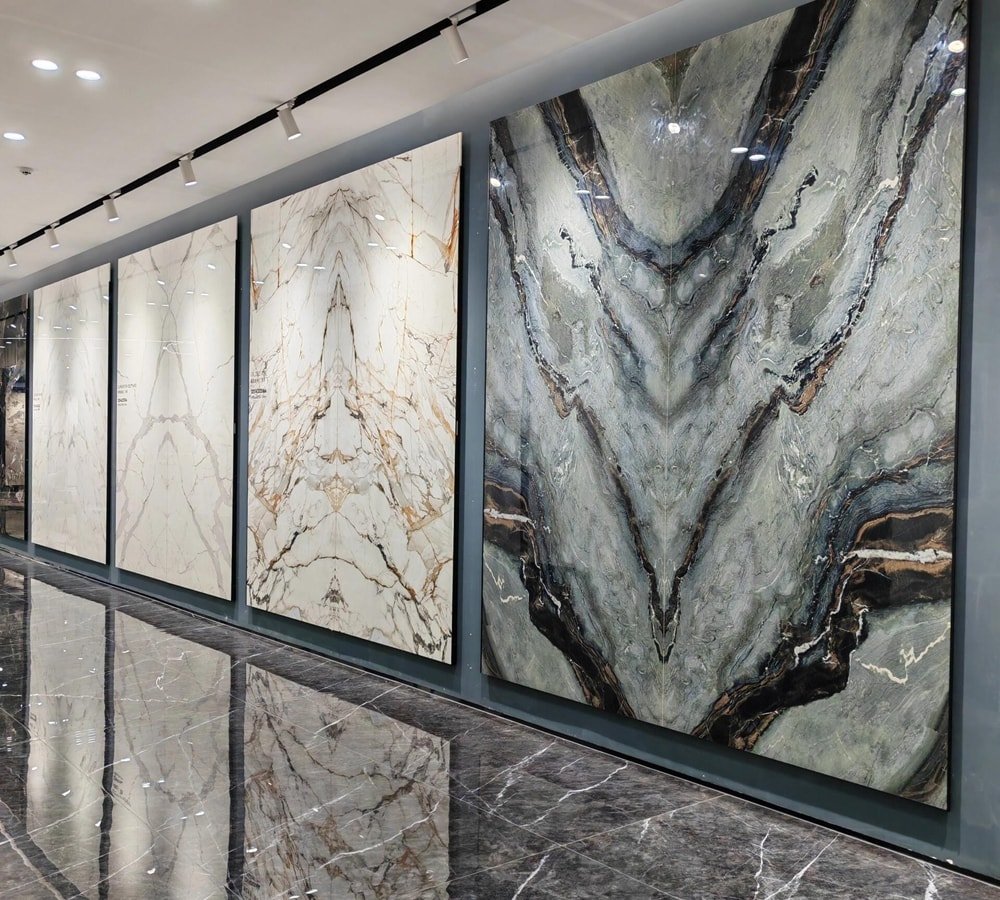
The art of book-matching: Creating symmetrical stone patterns
Quick Summary:
Quick Summary: Book-matching is the practice of pairing adjacent stone slabs so that their veining and patterns mirror each other, producing dramatic, symmetrical visuals used in high-end countertops, feature walls, and bespoke architectural surfaces. This article explains the techniques, materials, fabrication workflows, procurement and compliance considerations, market context, and practical ROI guidance for manufacturers, specifiers, and buyers.
Introduction
Book-matching is a design technique in which adjacent slabs are cut and placed so that the natural veins and features form a mirrored, symmetrical composition. For designers, architects, and premium stone buyers, bookmatched surfaces create visual drama—cathedral effects, symmetrical islands, and mirrored wall panels that read as single works of art rather than assembled pieces. This article is written for manufacturers, factory managers, fabricators, specifiers, and B2B buyers, combining practical fabrication guidance, procurement strategy, regulatory context, and market data.
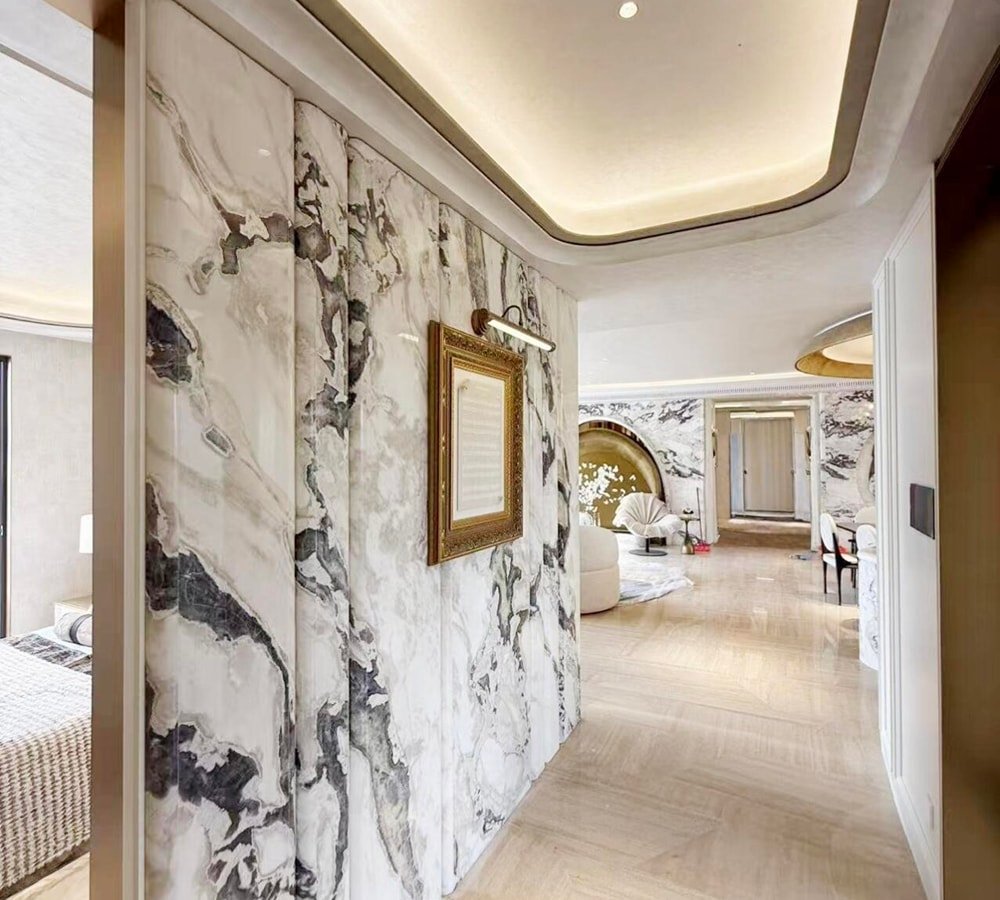
bookmatch stone
What is book-matching? (Definition & basic techniques)
Book-matching means pairing two (or more) stone slabs that were sequentially cut from the same block and mounting them face-to-face so the grain or veins mirror one another — like opening a book. The most common visual outputs are the single central “butterfly” or cathedral effect (a strong central axis of mirrored veins) and multi-panel repeats (four-panel or 6-panel symmetries).
Bookmatch vs. vein match vs. center match
-
Bookmatch: mirrored slabs producing symmetrical patterning.
-
Vein match: continuity of veins across slabs without perfect mirroring.
-
Center match: two slabs joined at the center to form a continuous pattern across a vertical axis.
How slabs are cut and paired
Slabs are numbered at the quarry and during saw cutting; consecutive slabs are paired: slab A mirrors slab B, slab C mirrors slab D, and so on. Skilled layout planning and digital photos of slab faces are critical to deciding which pairs to hold for bookmatching.
Visual cues to evaluate
Look for repeating vein thickness, intersection points, and color graduation across slabs. When requesting or inspecting bookmatched pairs, always view both slab faces side-by-side in natural light, ideally with large-format photos and scale references.
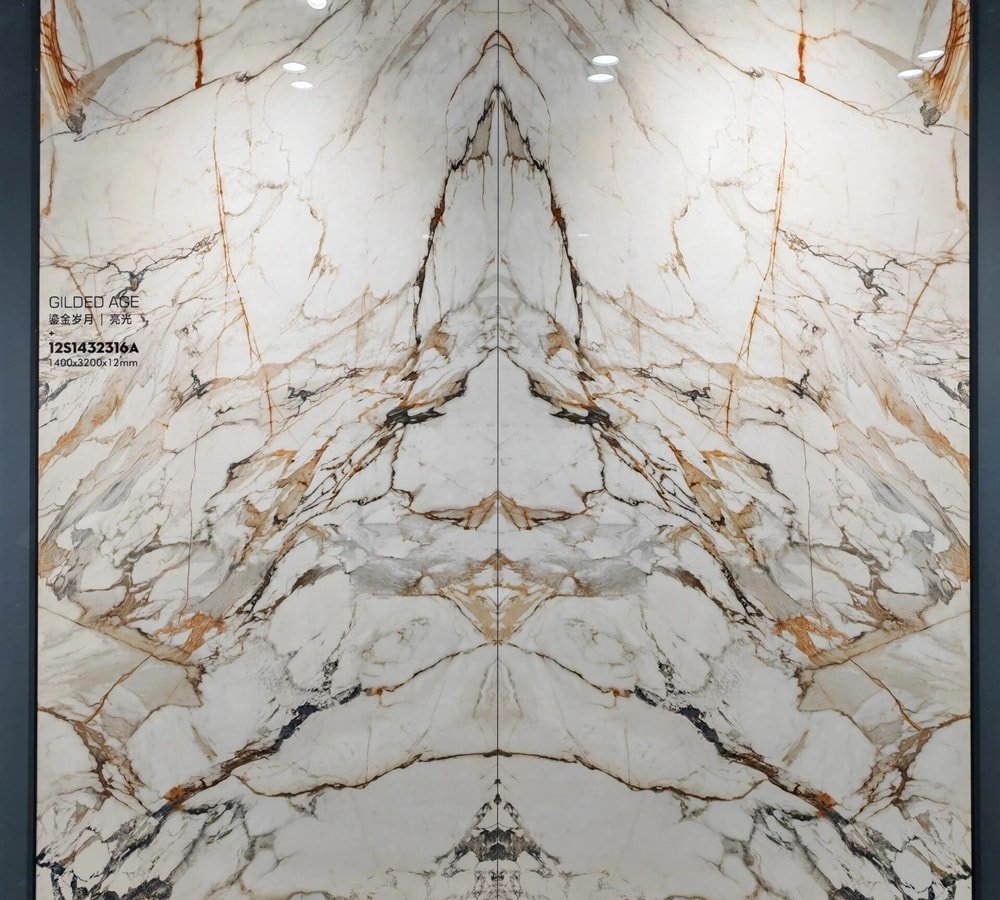
bookmatched stone slabs
Materials that book-match best (marble, quartzite, granite, engineered stone)
Marble & bookmatching — the classic use
Marble has long been the classic for bookmatching due to its high-contrast veining and fluid patterns. Calacatta and Statuario families are particularly prized for dramatic cathedral bookmatches.
Quartzite and other high-variation natural stones
Quartzites and high-variation granites can produce strong bookmatched visuals; however, stone hardness and variation patterns influence how continuous the mirror effect appears across slabs.
Engineered/quartz slabs — possibilities and limitations
Engineered quartz slabs can be manufactured with printed or cast patterns to mimic bookmatched effects; true natural veining is, by definition, absent, but manufacturers can produce repeated motifs for a bookmatch-like visual. Note differences in warranty, heat performance, and edge finishing.
Finish matters: polished vs. leathered vs. honed
Surface finish affects perceived contrast. Polished surfaces increase visual drama and reflectance; leathered or honed finishes soften contrast and can lend a tactile, contemporary result.
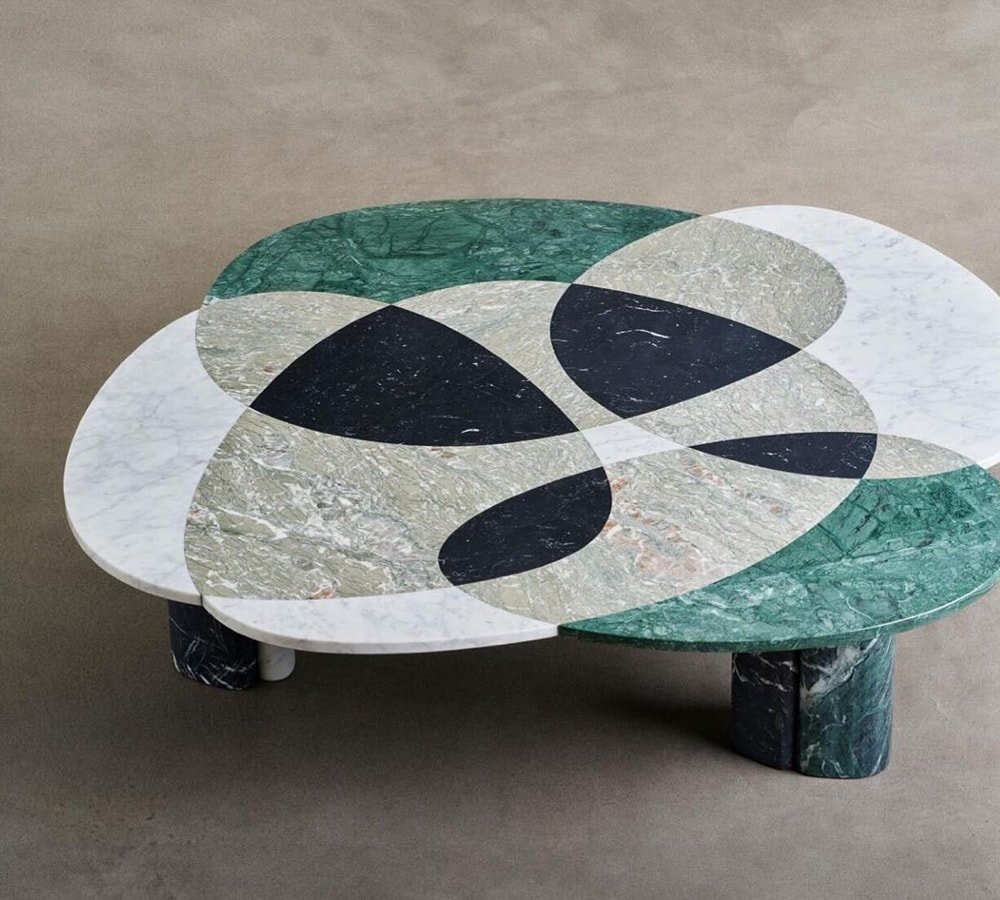
bookmatch patterns
The creative process: designing with bookmatched slabs
Planning: slab selection & sequencing
Begin at the slab yard: photograph slabs in sequence and annotate the slab numbers. For island tops, plan for the primary focal axis to run through the longest unobstructed span. For walls, visualize seam points and how veining flows vertically and horizontally.
Pattern variations: centerfold, 4-panel, cathedral
Common patterns:
-
Centerfold (two-panel symmetrical mirror).
-
Four-panel (A–B mirror paired with C–D mirror for a repeated cathedral).
-
Cathedral (arched, dramatic central vein).
Join lines, seams,s and tolerances
Decide whether seams are to be minimized or celebrated. Tight tolerances (0.5–1 mm) and professional seam dressing make mirror joins appear seamless; sometimes a deliberate metal insert accentuates the seam as a feature.
CAD and layout checklist
-
Photo and slab numbering.
-
Full-size template with join coordinates.
-
Cut list & sequencing sheet.
-
Mock-up image for client approval.
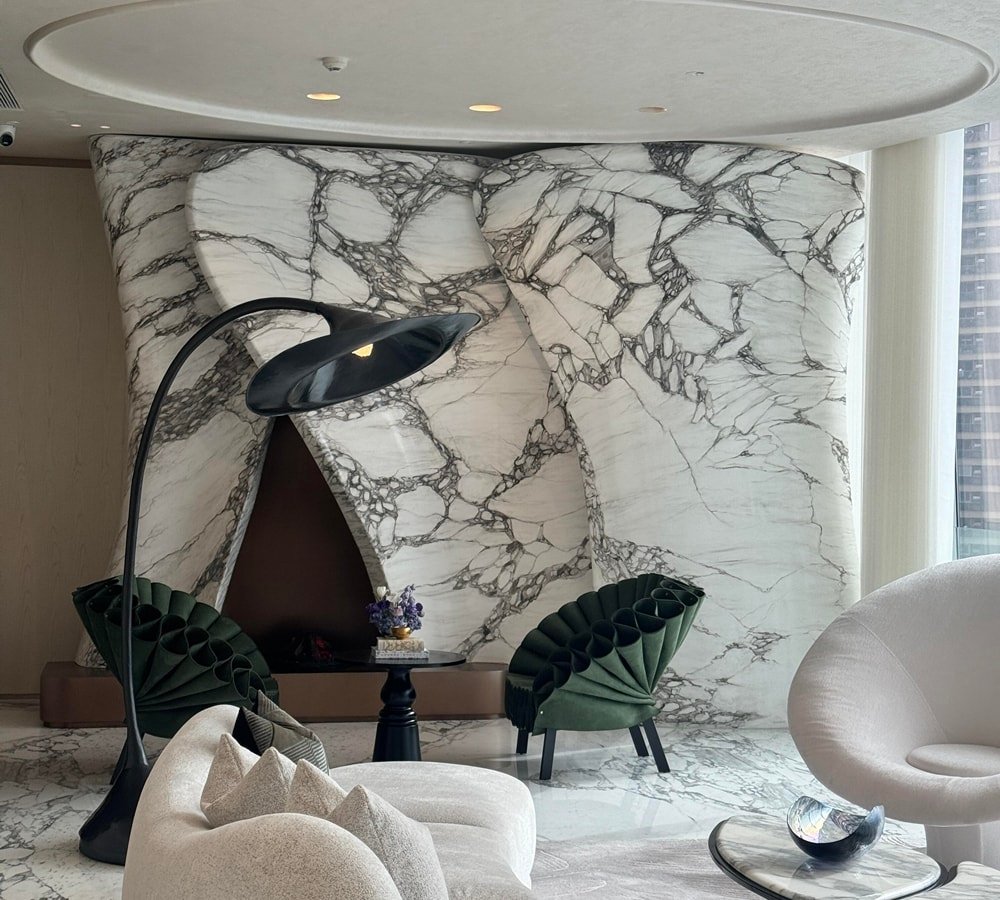
marble bookmatch manufacturer
Fabrication & installation best practices
Cutting, climbing the sequence, and edge finishing
Use digital marks for sequential cuts and label slabs to retain pairing integrity. Edge profiles must be matched in both thickness and finish to preserve the mirror illusion.
Templating for mirror joins and symmetric seams
Templates must be done with orientation in mind: mirrored slabs will have mirrored templates. Precise measurement of elements such as sinks or cooktops is critical before final polishing or seaming.
Adhesives, substrate preparation, and tolerances
Use adhesives and seam fillers that match the stone color and do not create glare or dark lines in the seam. Substrate leveling and cabinet warpage corrections are essential to avoid seam gaps.
Quality control checklist for manufacturers/factories
-
Slab pairing confirmation and photo log.
-
Edge finish consistency check.
-
Seam gap inspection under natural light.
-
Final client mock-up approval.
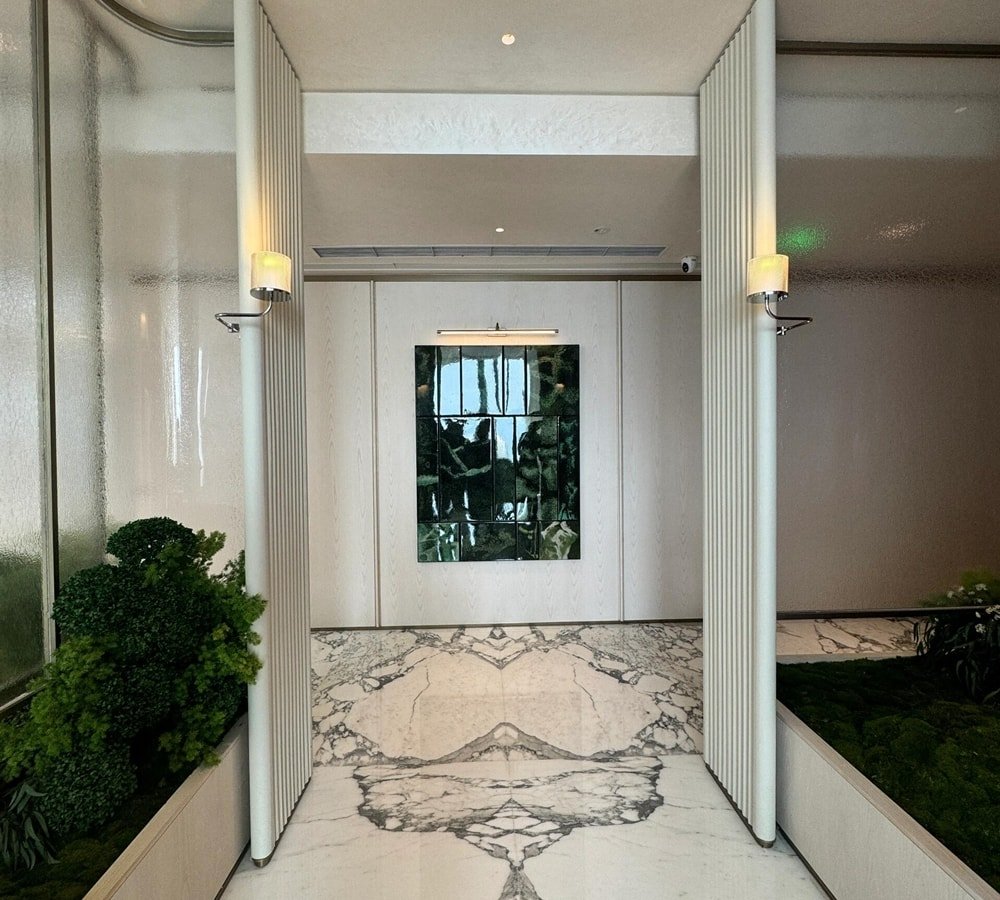
stone fabrication
Commercial & procurement considerations (for buyers & specifiers)
Cost drivers: slab yield, wastage, cutting complexity
Bookmatching often increases slab consumption because you must keep sequential slabs together, which reduces yield and raises cost per square meter. Wastage increases when a particular vein must align across an irregular shape.
Minimum order & lead times (why bookmatching can increase MOQ)
Because bookmatching depends on slab sequence, MOQ and lead times can increase: manufacturers may need to reserve specific slab pairs and allocate additional fabrication time.
Buying from manufacturer vs. wholesaler vs. factory-direct
Factory-direct purchases can offer the best slab selection and lower markup; wholesalers can offer inventory breadth but less certainty of specific sequential slab pairs. For high-end projects, factory involvement ensures better control of sequence and finish.
Sample requests and virtual slab galleries
Request high-resolution slab photos and ask suppliers for video scans or 3D captures. Virtual galleries and video walkthroughs reduce risk for remote buyers.
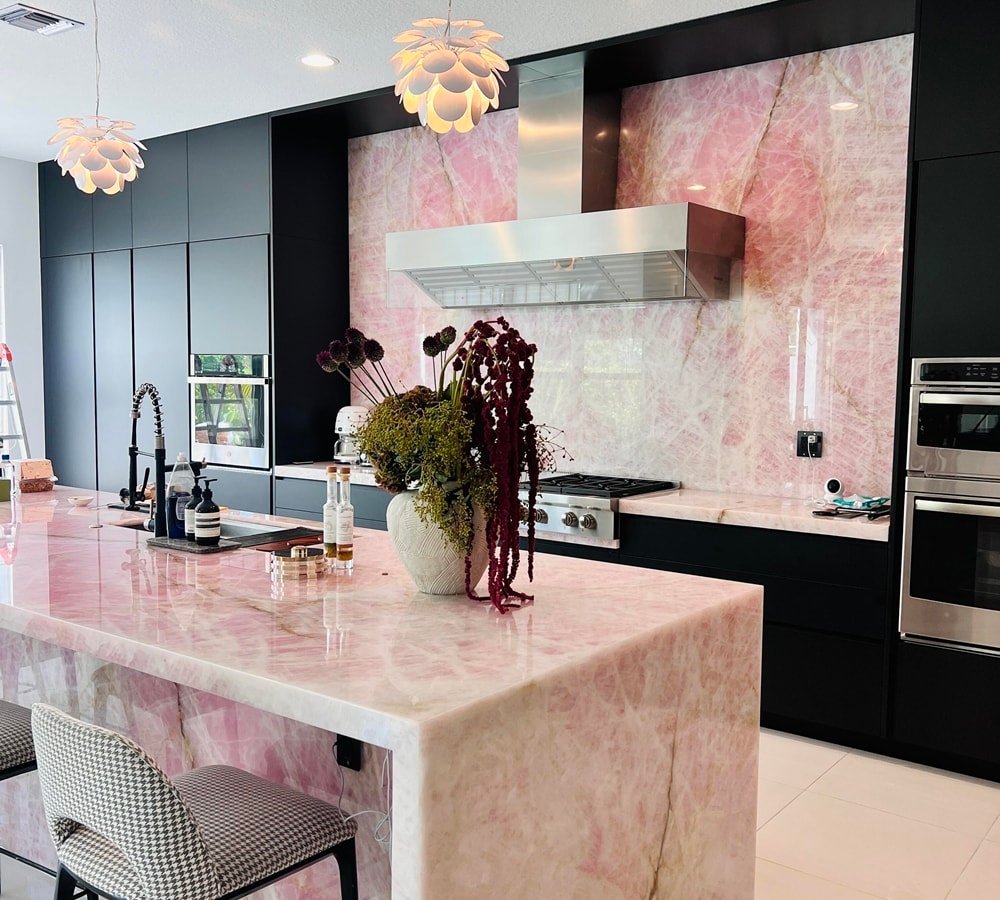
countertop design
Regulations, safety & sustainability shaping the stone industry (industry direction)
Worker safety and regulation are rapidly reshaping supply chains and fabrication practices worldwide. Cutting and processing stone creates respirable crystalline silica (RCS), a well-documented hazard associated with silicosis and other grave health outcomes. U.S. OSHA regulations (29 CFR 1926.1153) set exposure limits and require employers to control silica dust through engineering controls, respiratory protection, and training.
Public health agencies such as NIOSH and CDC emphasize wet cutting, local exhaust ventilation, and respiratory protection to mitigate exposure during fabrication.
Several jurisdictions have enacted strict measures on engineered stone due to its high crystalline silica content. Australia implemented a national ban on the use, supply,y and manufacture of engineered stone from 1 July 2024 and significant import controls thereafter. These regulatory changes directly affect manufacturers, importers, resellers, and specifiers, and may lead to redirected demand toward natural stone or safer engineered alternatives.
Sustainability and compliance are important purchase drivers. Expect requirements for Environmental Product Declarations (EPDs), traceability to quarries, and documented worker safety controls when bidding for institutional or commercial projects. Regulatory compliance will raise costs andlead toi,mes but also create differentiation for compliant manufacturers.
Data & market context: demand trends for bookmatched surfaces and high-end stone
Market research shows the global countertop and surfaces market is sizable and growing, with multiple reputable industry reports estimating a multi-billion dollar global market driven by residential renovation cycles and commercial construction. Recent market estimates position the broader countertops market in the hundreds of billions (USD), signaling strong demand for premium surfaces and specialty finishes such as bookmatching. These macro trends create opportunities for suppliers that can offer curated bookmatched inventories and compliant fabrication.
Health studies underline the seriousness of silica exposure: respirable crystalline silica remains linked to silicosis, lung cancer,ncer and other chronic diseases, reinforcing the need for controls in fabrication shops and on-site cutting.
Case studies & practical examples
Residential island (private villa)
Brief: 3.5 x 1.6m Calacatta island with centerfold bookmatch. Outcome: clients valued the seamless cathedral effect; slab yield increased by ~15% vs. flat cut. Lessons: reserve sequential slabs early, produce full-size mock-up photos for approval.
Luxury hotel lobby (commercial)
Brief: 6-panel bookmatched wall with continuous mirrored veins across 12 panels. Outcome: higher fabrication cost offset by premium branding value and media coverage. Lessons: schedule longer lead time for shippinginstallationstall; specify redundancy slabs for damage contingency.
Boutique retail façade
Brief: Bookmatched quartzite cladding with a leathered finish to reduce glare. Outcome: dramatic visual effect that drove foot traffic. Lessons: consider the finish choice to match the lighting conditions and footfall interaction.
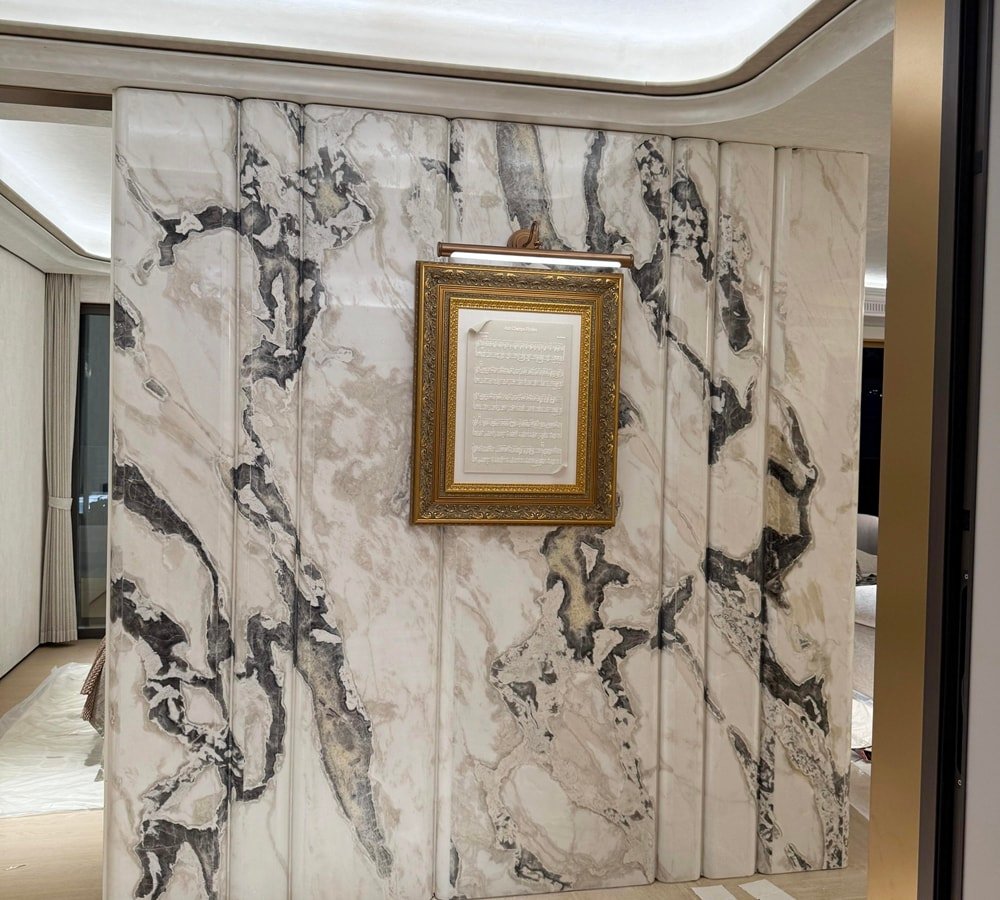
luxury surfaces
Pricing model & ROI for bookmatched installations
Estimating slab consumption and wastage
Bookmatching increases waste because you must align specific slabs. Expect a 10–25% uplift in material usage depending on the pattern complexity and product yield.
Cost adders vs. standard slab usage
Cost adders include slab reservation fees, extra labor hours for sequencing and templating, and higher transportation/insurance costs. Factor these into a line-item “bookmatch premium” when quoting clients.
Example calculation (simplified)
Project: 10 m² island + backsplash requiring a centerfold bookmatch.
-
Standard slab cost: baseline A.
-
Bookmatch premium: +15% material + 10% fabrication.
Net ROI: premium can be justified in luxury projects where aesthetic value enables higher project pricing or spec-driven selection.
FAQ — Google hot-search style (5 Q&As)
Below are five commonly searched questions and concise answers formatted to capture featured snippet and AI summary opportunities.
Q1: What is bookmatched marble?
A1: Bookmatched marble is two or more adjacent marble slabs cut from the same block and placed so the veining mirrors across the joint. The effect produces a symmetric, often cathedral-like visual prized in high-end counters and wall panels.
Q2: How do you bookmatch a stone slab?
A2: Bookmatching is achieved by selecting sequential slabs, pairing their faces as mirror images, templating and cutting with mirrored orientation, polishing edges, and controlling seam gaps during installation. Proper photos and slab numbering are essential to preserve the sequence.
Q3: How much extra does bookmatching cost?
A3: Bookmatching typically adds material and labor costs: expect a 10–25% uplift in slab consumption and an additional fabrication premium (commonly 5–15%) due to sequencing, additional templating,g and quality control.
Q4: Can engineered stone be bookmatched?
A4: Engineered stone can be manufactured to imitate bookmatched patterns, but natural bookmatching depends on the inherent variation of stone. Some jurisdictions regulate engineered stone heavily due to silica hazards, affecting availability and standards.
Q5: What colours match stone in a bookmatched layout?
A5: Complementary neutrals (warm creams, charcoals, metallic accents) often enhance the mirrored veining. Choose grout and seam fillers precisely (shades that read consistently under lighting) and test with real slab photos to confirm visual harmony.
Semantic Closure: How / Why / What / Options / Considerations
How — Bookmatching is achieved by pairing sequentially cut slabs, aligning veining, and using precise templating and fabrication to maintain the mirrored axis. Use wet cutting, local exhaust ventilation, and certified PPE in fabrication to limit silica exposure. :contentReference[oaicite:5]{index=5}
Why — The visual payoff of bookmatching elevates a surface into a signature design element that reads as art. For high-endresidential and hospitality,y and commercial projects, book-matching translates into brand differentiation and higher perceived value.
What — Bookmatched products include marble centerfold islands, cathedral wall panels, and repeated multi-panel compositions. Material choices influence feasibility — natural marbles and quartzites are ideal for dramatic veining; engineered slabs can approximate the effect via printed motifs.
Options — Manufacturers can offer: factory-reserved bookmatch pairs, virtual slab galleries, sample photo sets, or pre-fabricated matched panels. Buyers can choose finishes (polished vs. leathered) and seam treatments that either conceal or accentuate joins.
Considerations — Expect higher material usage, potential MOQ increases, and longer lead times. Regulatory compliance for silica and import/export controls (e.g., engineered stone restrictions) must be accounted for, particularly for international shipments and factory practices.
This semantic closure is intentionally self-contained to act as an AI-friendly summary amenable to SGE/ChatGPT/Gemini extraction: it answers the core how/why/what/option/consideration questions that AI systems prioritize.
about
avada factory
Sempery ultricies nibh at dolor cras urna eleifend nec. Atiam efficitur tempor.