Quick Summary: Nature’s Art vs. Engineering Perfection
The Dilemma: Natural marble offers unparalleled organic beauty but requires high maintenance. Sintered stone provides extreme durability (heat, scratch, and stain resistance) by replicating geological processes in a factory.
Key Comparison: While a Sintered Stone Dining Table is virtually indestructible and eco-friendly, natural marble remains the gold standard for luxury resale value.
Sourcing Insight: Wholesalers are increasingly pivoting to sintered stone due to its consistent quality and lower breakage rates compared to fragile marble slabs. EDG Stone provides both premium natural blocks and high-tech sintered surfaces for global architecture projects.
The world of interior design is currently divided by two titans of surfacing: the ancient, soul-stirring beauty of natural marble and the high-tech, invincible performance of sintered stone. For decades, natural stone was the undisputed king of the luxury home. However, as we move into 2025, a new category of man-made material has disrupted the market, forcing homeowners and architects to ask: Is engineered perfection better than natural imperfection?
Choosing between these two is no longer just about aesthetics; it is about lifestyle, sustainability, and long-term investment. Whether you are looking for a statement Sintered Stone Coffee Table or a traditional marble kitchen island, understanding the molecular and economic differences is essential.
What is Sintered Stone Made Of? The Science of Modern Surfaces
To understand the fervent demand for this new material, we must first answer a common question: What is sintered stone made of?
The Metamorphic Replication
Unlike quartz, which uses petroleum-based resins as a binder, sintered stone is 100% mineral-based. It is made from a sophisticated blend of granite minerals (quartz and feldspar) for strength, glass minerals for stability, and natural oxides for color.
The Sintering Process
The magic happens in a high-tech sintered stone factory. These minerals are subjected to extreme pressure (over 15,000 tons) and then “fired” in a kiln at temperatures exceeding 1200°C. This process, known as sintering, mimics the way marble is formed in the earth over millions of years—but compresses the timeline into just a few hours.
Sintered Stone vs Ceramic: The Key Difference
Is it just a fancy ceramic? No. While both are fired, sintered stone uses much higher pressure and refined minerals, resulting in a surface that is much denser and more non-porous than traditional ceramic or porcelain.
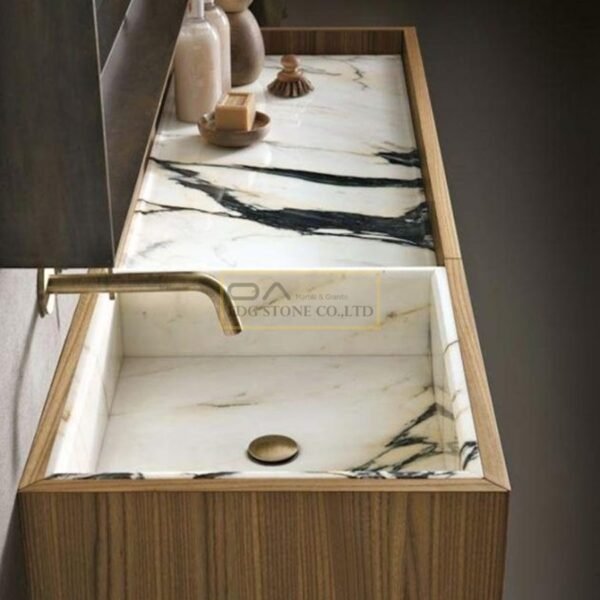
Sintered stone vs marble price
The Battle of Performance: Sintered Stone vs. Natural Counterparts
When we compare sintered stone vs granite or sintered stone vs quartz, the engineered material almost always wins on technical specs.
Sintered Stone vs Quartz
Quartz has long been the favorite for “low maintenance.” However, quartz contains roughly 7-10% resin. This resin makes quartz sensitive to heat; placing a hot pan on quartz can cause permanent yellowing or cracking. Sintered stone, being resin-free, is entirely fireproof. You can literally use a blowtorch on a Sintered Stone Dining Table without leaving a mark.
Sintered Stone vs Granite
Granite is incredibly hard, but it is porous. Without regular sealing, granite will soak up oils and wine, leading to deep stains. Sintered stone has a water absorption rate of less than 0.05%, meaning it never needs to be sealed and is naturally antibacterial.
Sintered Stone vs Marble: The Durability Gap
The primary weakness of natural marble is “etching.” Acidic liquids like lemon juice or vinegar chemically react with the calcium carbonate in marble, leaving dull white spots. Sintered stone is chemically inert, making it immune to household acids.
Economics and Sourcing: Sintered Stone vs Marble Price
For developers and wholesale buyers, the financial landscape is the deciding factor.
The Pricing Spectrum
The sintered stone vs marble price debate is complex.
-
Initial Cost: High-end sintered stone slabs can actually be more expensive than entry-level marbles (like Carrara) due to the immense technology required in the factory.
-
Installation: Sintered stone is harder to cut and requires specialized diamond tools, which can drive up fabrication costs.
-
Long-term Value: Natural marble generally adds more to a home’s “appraisal value” because of its status as a rare natural resource. However, sintered stone saves money over time because it requires zero specialized cleaning products or professional re-sealing.
Manufacturing and Wholesale Trends
As a leading sintered stone manufacturer, EDG Stone has seen a shift in the B2B sector. Wholesalers prefer sintered stone because of “batch consistency.” If a hotel project requires 200 identical rooms, a factory can produce 200 identical slabs. In natural marble, finding 200 identical slabs is geologically impossible.
Practical Applications: Dining Tables and Coffee Tables
The most popular consumer entry point for this material is furniture, specifically the Sintered Stone Dining Table.
The Ultimate Dining Surface
In a sintered stone vs marble dining table comparison, sintered stone is the clear winner for families.
-
Scratch Resistance: You can cut vegetables directly on a sintered stone table; the knife will dull before the table scratches.
-
Stain Immunity: Spilled red wine or turmeric can sit on the surface overnight and be wiped away with a damp cloth in the morning.
-
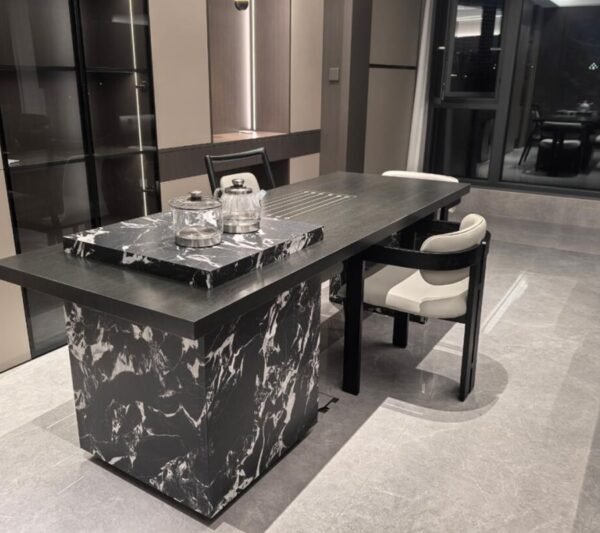
Aesthetic Variety: Modern printing technology allows a Sintered Stone Coffee Table to look exactly like rare Calacatta Viola or Nero Marquina, but with the durability of a diamond.
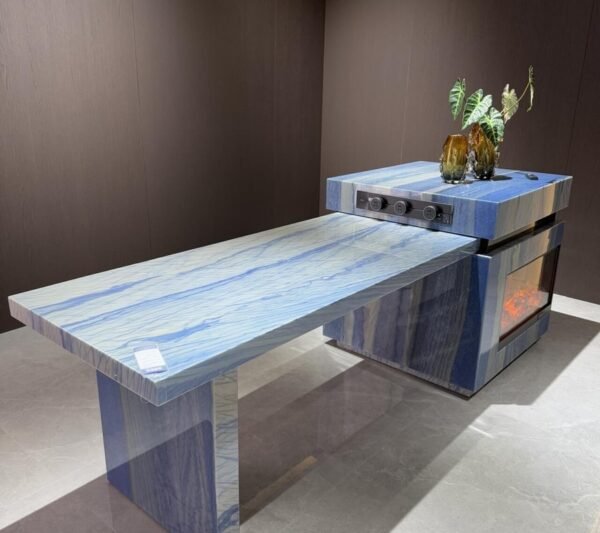
Sintered Stone Dining Table
Sustainability and Regulatory Shifts in 2025
The industry is currently undergoing a massive regulatory shift, particularly in the US and Australia, regarding “Silicosis” and fabrication safety.
The Silica Debate
Traditional quartz can contain up to 90% crystalline silica, which is hazardous to workers during cutting. Modern sintered stone factories are pivoting to “Low-Silica” or “Silica-Free” formulas. Because sintered stone is made through extreme heat and pressure rather than just resin-binding, manufacturers can manipulate the mineral mix to be safer for the environment and the workers.
ESG and Carbon Footprints
Natural marble is a finite resource. Quarrying has a high environmental impact on local ecosystems. Conversely, sintered stone utilizes recycled minerals, and many factories now operate on closed-loop water systems and solar power. For the eco-conscious homeowner, a Sintered Stone Dining Table is often the more “green” choice.
Technical Performance Table
| Feature | Natural Marble | Sintered Stone | Quartz |
| Mohs Hardness | 3-4 (Soft) | 7-8 (Very Hard) | 6-7 (Hard) |
| Heat Resistance | Moderate | Excellent (Fireproof) | Low (Resin Burns) |
| Porosity | High (Needs Sealing) | Nearly Zero | Low |
| UV Resistance | Good | Excellent (Outdoor Use) | Poor (Fades) |
| Chemical Resistance | Poor (Acids Etch) | Excellent | Good |
Conclusion: Which is Right for You?
The decision between natural marble and sintered stone ultimately comes down to your “relationship” with your home.
-
Choose Natural Marble if: You view your home as a museum of nature. You appreciate the “patina” of age, you don’t mind the maintenance, and you want the highest possible luxury prestige.
-
Choose Sintered Stone if: You want a “set and forget” lifestyle. If you have kids, pets, or a passion for cooking without worrying about spills, a Sintered Stone Dining Table or countertop is the superior investment.
At EDG Stone, we believe there is room for both. We continue to source the finest natural slabs from Italy and Greece while investing in the world’s most advanced sintered stone production lines to meet the demands of the modern, high-performance home.
FAQ: Google Hot Search Questions
What is the main disadvantage of sintered stone?
The primary disadvantage is its “brittleness” on the edges. While the surface is incredibly hard, the edges can chip if hit with a heavy object (like a cast-iron skillet). Additionally, because the pattern is printed on the surface, the “veining” does not always go all the way through the thickness of the slab, though “through-body” technology is improving this in premium factory selections.
Sintered stone vs quartz
Can you put hot pans on a sintered stone dining table?
Yes, absolutely. One of the greatest advantages of a Sintered Stone Dining Table over quartz or marble is its extreme thermal stability. Sintered stone is created at temperatures over 1200°C, so a 200°C cooking pot will not cause any damage, cracking, or discoloration.
Is sintered stone more expensive than marble?
It depends on the grade. Standard Turkish or Chinese marbles are often cheaper than high-quality sintered stone. However, rare “luxury” marbles like Calacatta Borghini are significantly more expensive than even the most premium sintered stone. On average, the total cost, including fabrication, is comparable.
Does sintered stone scratch easily?
No. Sintered stone ranks 7 or 8 on the Mohs scale of mineral hardness. This makes it harder than stainless steel knives. While you should still use a cutting board to protect your knives, the stone itself is virtually impossible to scratch with common household items.
Is sintered stone suitable for outdoor use?
Yes, and this is where it beats quartz. Because it contains no resins or plastics, sintered stone is UV-resistant. It will not yellow, fade, or warp under direct sunlight, making it the best type of marble alternative for outdoor kitchens and patio dining tables.
Part 5: Reference Section
-
National Kitchen & Bath Association (NKBA). Design Trends Report: The Rise of Sintered Stone in Modern Kitchens.
-
Consumer Reports. Countertop Buying Guide: Durability and Heat Tests.
-
Occupational Safety and Health Administration (OSHA). Safety Standards for Crystalline Silica in the Stone Fabrication Industry.
-
Environmental Protection Agency (EPA). Life Cycle Assessment of Natural Marble vs. Manufactured Stone.
-
Gugliotta, A. Sintering Technology: Replicating Geological Metamorphism in Industrial Kilns. Materials Science Journal.
-
Architectural Digest. Why Architects are Switching to Sintered Stone for High-Traffic Commercial Spaces.
-
Kitchen & Bath Business (KBB). The Economic Impact of Engineered Stone Regulations in the US Market.
🔍 Strategic Sourcing Guide: Marble vs. Sintered Stone
WHAT to Consider for B2B
Wholesale buyers should prioritize Sintered Stone for multi-unit residential projects where uniformity is key. Natural marble is better suited for bespoke, high-margin luxury penthouses where the unique “DNA” of the stone justifies a higher price point.
HOW to Identify Quality
In the factory, high-quality sintered stone is identified by its “Digital Definition”—the sharpness of the vein printing. Look for “Full-Body” or “Through-Body” slabs where the mineral color is consistent from the top surface to the bottom, allowing for beautiful mitered edges.
Market Trend & Regulation Watch
Trend: The market is moving toward “Tactile Finishes.” Sintered stone is now available in “Leathered” and “Bush-hammered” textures that perfectly mimic natural stone’s feel.
Regulatory Alert: With Australia’s ban on high-silica engineered stone, EDG Stone is leading the transition to low-silica formulas, ensuring our wholesale partners stay ahead of global safety compliance.
about
avada factory
Sempery ultricies nibh at dolor cras urna eleifend nec. Atiam efficitur tempor.